


Richard Savage’s Tragedy of Sir Thomas Overbury: Johnson’s Critique and the Manuscript Revision
Richard Savage’s contemporaries praised the quality of his writing, as did Samuel Johnson. In his Life of Savage, Johnson described Savage as “a man whose writings entitle him to an eminent rank in the classes of learning,” and praised especially the quality of The Wanderer, The Bastard, The Triumph of Health and Mirth, and the last of the Volunteer Laureat poems. Nearly 300 years after his death, however, Savage is known far less for his own writing than as the subject of Johnson’s Life of Savage. Johnson’s portrait of Savage is psychologically perceptive, sympathetic, and compelling, but it has had the paradoxical effect of making Savage’s actual literary output difficult to approach on its own terms. Scholars have been irresistibly drawn to the narrative of disenfranchised aristocracy that Savage pushed, with varying degrees of explicitness, throughout his career, and, as a result, what little interest Savage’s work garners nowadays remains largely biographical in orientation.
The Bastard and The Volunteer Laureat poems are works whose literary interest is nearly inseparable from the public identity they construct. Savage’s other poetry returns more indirectly (but persistently) to themes of exclusion, neglected merit, and dispossessed identity. In these works, the author keeps his sense of injury continuously before his readers. The result is that Savage’s works have rarely received sustained critical examination independent of the life that produced them. They are treated as evidence about Savage, rather than as works of art in their own right.
Savage’s dramatic works present a partial exception to this pattern. The Tragedy of Sir Thomas Overbury, Savage’s most sustained literary effort, does not advance his biographical claims directly — apart from a conspicuous declaration on the title page — and might therefore seem available for evaluation on other grounds.1 That it has not received such examination is the consequence of several obstacles, some of which Johnson’s own account makes clear. Johnson records Savage’s deep dissatisfaction with the 1724 version of the play — a dissatisfaction strong enough to prompt a resolution to rewrite the tragedy entirely.2 For later readers, this presents a substantial problem: the author himself regarded the 1724 version as inadequate. He began a revision and substantially completed it; however, he was stranded in Bristol and unable to return to London to see the revised play produced. He died in Bristol, in debtors’ prison, in August of 1743.
The manuscript of Savage’s rewritten play eventually passed into the hands of William Woodfall, whose 1777 Covent Garden production, together with the edition he published that same year, presented a version of the revision. In an “Advertisement” prefixed to the 1777 edition, Woodfall noted that the revised play required additional editorial intervention before it could be brought to the stage. Without access to the manuscript itself, no reliable assessment of Savage’s actual revision was possible for many years. The combined effect of the author’s dissatisfaction with the original play, the uncertainty surrounding Woodfall’s adaptation, and the long inaccessibility of the manuscript discouraged sustained critical inquiry.
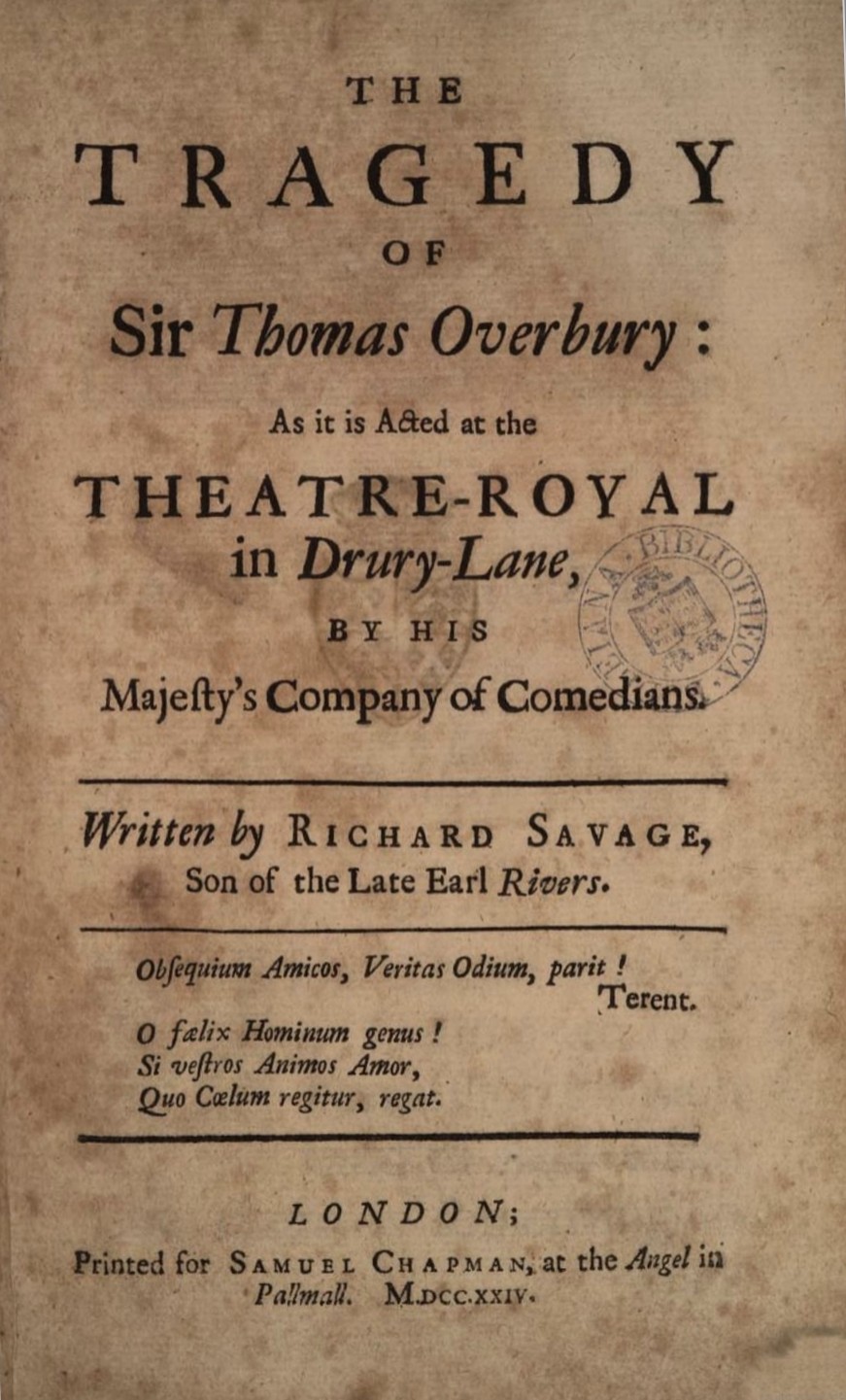
Figure 1: The title page of the 1724 edition of Sir Thomas Overbury includes features Savage’s version of his parentage.
Johnson’s critical remarks on the play in his Life of Savage pose the questions I undertake to answer in this article. Johnson approves of the subject as well suited to the stage, but he expresses reservations about the historical events being “perhaps not far enough removed from the present Age, to admit properly the Fictions necessary to complete the Plan.”3 Johnson later records Savage’s resolution to write an entirely new tragedy on the Overbury story, but he had no means of determining whether Savage succeeded in improving the play. What made the Overbury story suitable in Johnson’s view, and what did its historical proximity cost the play? What weaknesses did Savage himself identify in the original version, and how successfully was he able to address them in his revision? Examination of the manuscript alongside the 1724 printed edition allows these questions to be considered directly, focusing the inquiry on Savage’s dramatic ambitions and the extent to which the revision fulfilled them.
This article examines the 1724 Tragedy of Sir Thomas Overbury as a dramatic work in its own right, describes the nature of the manuscript revisions, assesses the revision’s achievements and its limitations and shortcomings, and evaluates the relationship between Savage’s manuscript and Woodfall’s 1777 edition. It is, to the best of my knowledge, the first critical examination of the play since Woodfall’s own remarks accompanying the 1777 edition, and the first account of the manuscript revision based upon direct examination of the manuscript itself.4
The Overbury Scandal
Sir Thomas Overbury — courtier, poet, and victim of one of the most sensational court intrigues of the Jacobean era — was born in Warwickshire in 1581, educated at Oxford, and admitted to the Middle Temple. During a visit to Edinburgh in 1601, he met Robert Carr, then a page to the Earl of Dunbar, and the two formed a friendship that would shape both their fates.
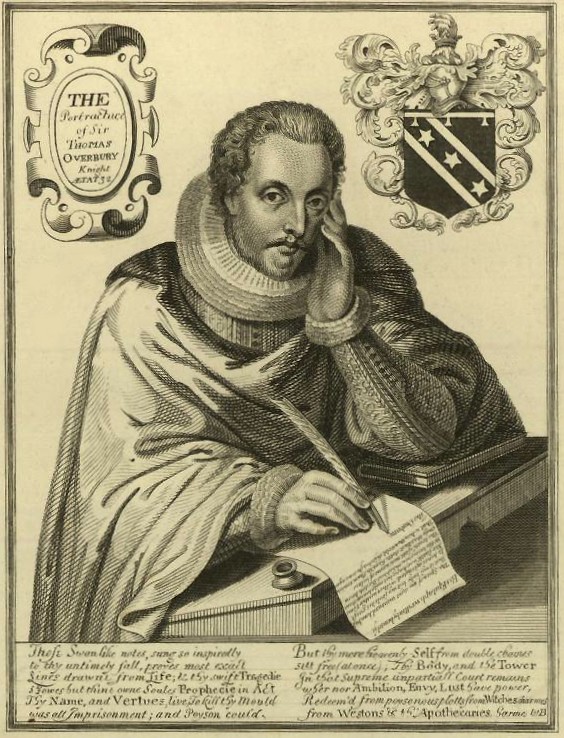
Figure 2: Engraving of Sir Thomas Overbury, Knight, Age 32, c.1615-16; public domain, Wikipedia.
When James I came to London in 1603, Carr quickly became his favorite, rising rapidly in wealth and influence. Overbury attached himself to Carr by 1605, offering political counsel that the personable but poorly educated Carr needed. Each man had something the other needed: Carr had the King’s favor; Overbury had much greater political intelligence.
Into this arrangement came Frances Howard, daughter of the Earl of Suffolk. In 1606, at thirteen, she was married to Robert Devereux, third Earl of Essex, in a match engineered by the King to reconcile two rival noble families. Immediately after the nuptials, Essex went abroad to continue his studies, leaving Frances at court, where she allegedly took up with Prince Henry before setting her sights on Carr. Overbury initially assisted the affair, composing love letters for the inarticulate Carr — partly out of loyalty, partly, it was said, out of spite toward the Howards.
When Essex returned in 1609, his wife refused to consummate the marriage. After three years of domestic stalemate, Frances began pursuing a divorce on grounds of nullity, backed by Carr and her great-uncle, the Earl of Northampton. The King was persuaded to support the divorce, and Essex, humiliated, eventually cooperated.
Overbury became the obstacle. Recognizing that the marriage would consolidate Howard power at court and diminish his own, he advised Carr against it in increasingly intemperate terms. He also composed a poem, The Wife, ostentatiously defining ideal womanhood — a transparent attack on Frances’s character. The poem only deepened the rift between Carr and Overbury, and Carr resolved to remove him.
The King, resentful of Overbury’s influence over his favorite, was persuaded to offer Overbury a diplomatic posting to Russia. Carr — by then Viscount Rochester — advised Overbury to refuse the post, knowing that doing so would result in Overbury’s arrest. When Overbury refused, he was arrested, on April 21, 1613, and committed to the Tower as a close prisoner. While Northampton and Carr appear to have intended only to sideline Overbury until after the Essex divorce, the Countess had a more ambitious scheme. Through her friend, Anne Turner, she engaged an apothecary to supply poisons and had a trusted associate installed as Overbury’s under-keeper. The poisons were administered slowly over several months and produced a gradual decline. Overbury died on September 14, 1613, eleven days before the divorce was granted. The marriage of Carr — now Earl of Somerset — and Frances followed at Christmas, with the King presiding.
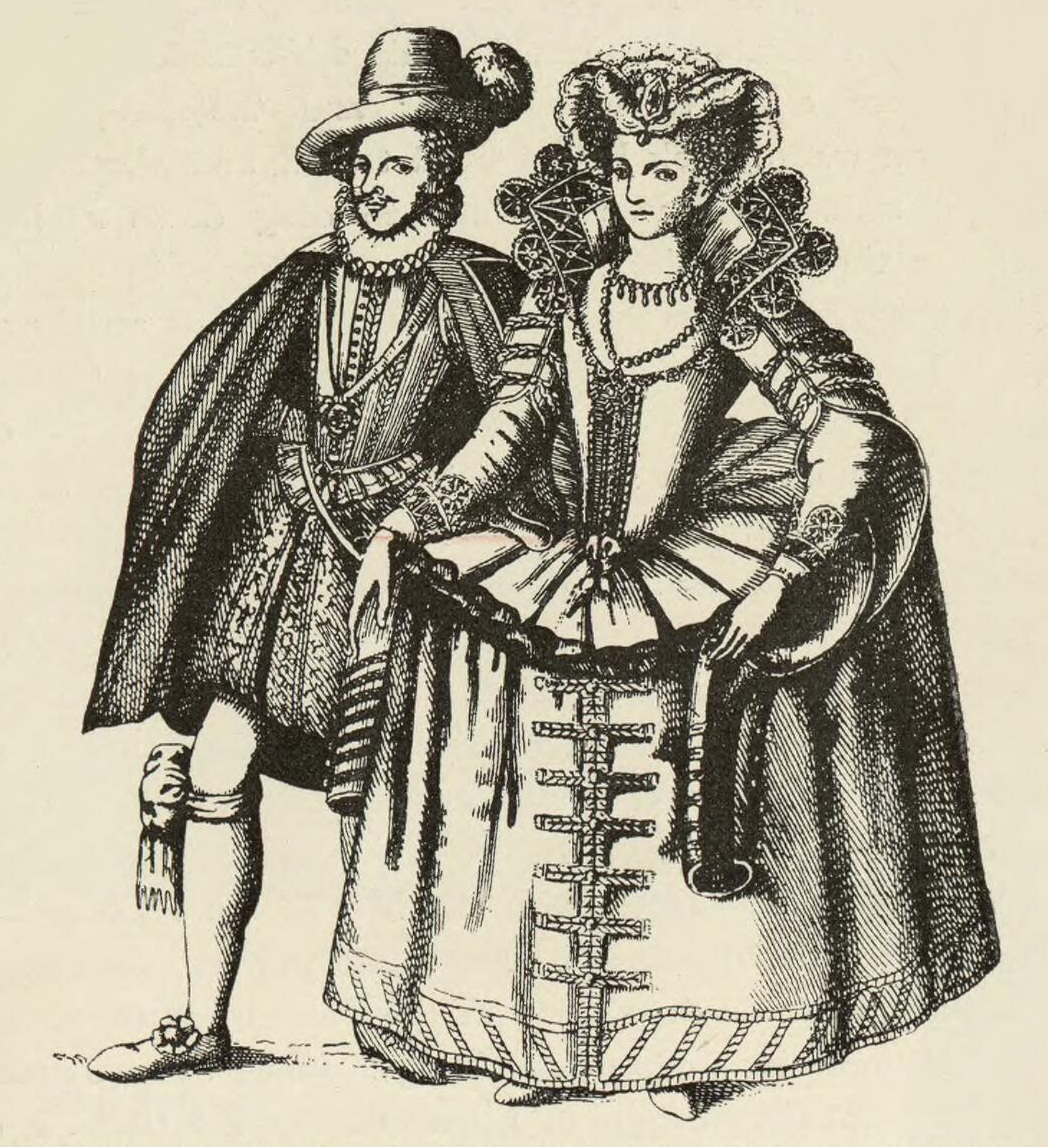
Figure 3: Robert Carr and Frances Howard, Earl and Countess of Somerset, after a contemporary engraving. Wikimedia Commons.
Overbury’s death went largely unremarked until Somerset began losing favor to the rising George Villiers two years later. An investigation was then launched, and in 1615 the four principal conspirators were tried, convicted, and hanged. The Countess pleaded guilty at her own trial and was eventually pardoned. Somerset, convicted on thinner evidence, refused to seek intercession from the now-powerful Villiers, Duke of Buckingham, and waited until 1625 for his pardon. The couple lived out their days in obscurity. One question was never resolved: the precise extent to which Northampton and Somerset had known of, or participated in, the murder plot itself.5
The 1724 Version: Johnson’s Assessment and Savage’s Alterations
Sir Thomas Overbury was by 1723 sufficiently removed from living memory to make his story available to the stage, though Johnson doubted whether the distance was yet sufficient for an audience to accept comfortably “the Fictions necessary to complete the Plan.” The story offered a playwright elements that Johnson found “well adapted to the Stage”: powerful passions, court intrigue, a virtuous protagonist destroyed by forces beyond his control, and a villainous female with considerable dramatic potential.
Savage recognized both the theatrical opportunity and its limitations. The historical events were too intricately woven — too dependent on the gradual unfolding of political circumstance — to be transferred to the stage without substantial alteration. His solution to this problem is revealing, and Johnson’s brief acknowledgment that Savage found it necessary to depart from the historical record opens the most productive critical questions the 1724 text raises: not whether Savage altered the facts, but how he did so, and to what purpose.
Johnson’s observation that Savage’s subject was a story well adapted to the stage is a useful starting point for criticism, for it directs attention to what Savage saw in the Overbury material and how effectively he shaped it for dramatic presentation. The differences between the historical record and Savage’s 1724 version fall into three broad categories: 1. changes in the sequence of events, 2. the invention of fictitious characters, and 3. the assignment of fictitious motives to historical characters.
The most immediately obvious of Savage’s departures from the historical record is his decision to begin the play with the Somerset marriage already accomplished. Historically, Overbury’s opposition to that marriage was the cause of his imprisonment; by presenting the marriage as a fait accompli, Savage compresses months of turmoil into a single moment of dramatic discovery, when Overbury returns from a brief absence to find his friend already married to the woman he had warned him against. The compression serves several purposes. It allows Savage to present Overbury as one whose wise counsel has been foolishly disregarded rather than as an active and sometimes indiscreet meddler in his friend’s affairs, and it shifts the focus from the circumstances of his imprisonment to the sinister plot to murder him. The result is a protagonist whose virtue is demonstrated in the context of the scene rather than through dialogue, and a plot that moves more directly toward its tragic conclusion.
The invention of two fictitious characters, Isabella and Cleora, allows Savage to develop Overbury’s character more fully and to manage the flow of information about the Countess’s machinations. Isabella is Overbury’s love. She provides a moral counterweight to the Countess — the one virtuous, reasoned, and constant, the other conniving and self-interested — and gives Overbury a gentler, more sympathetic dimension that his scenes with Somerset and Northampton alone could not supply. Without her, Savage would run the risk of presenting a protagonist so uncompromisingly virtuous as to seem remote from ordinary human experience. The other fictitious character, Cleora, serves two purposes. Isabella’s virtuous character is largely revealed through dialogue with Cleora, and Cleora functions also as a plot convenience, providing a means by which information about the Countess’s machinations reaches Isabella, and through her to Somerset, at a crucial moment in the action.
The invented motives reveal even more of Savage’s dramatic instincts. In the 1724 version, Northampton’s grounds for revenge are relatively schematic — Overbury’s interception of his treasonous letters to the court of Rome and Northampton’s subsequent exile from court, both attributed to Overbury’s interference — and his villainy is correspondingly straightforward.6 In the revision, Savage alters this, making Northampton the prime mover in the plot to murder Overbury and grounding his villainy in personal injury. As a villain bent on revenge, Northampton is made more believable; he has personal incentives for his part in the murder of Overbury. The historical Northampton seems to have been, at least initially, ignorant of the Countess’s plot to poison Overbury. By making him the prime mover in the plot, Savage gives his antagonist a psychological plausibility that a villain motivated by pure political ambition rarely achieves on stage.
Savage also reshapes the Countess’s motivations, going well beyond the historical record. By beginning the play with the Somerset marriage already in place, Savage must invent a more plausible reason for the Countess to seek revenge against Overbury, and he does this by suggesting that the Countess had improperly offered herself to Overbury, who had refused her advances. In this way, Savage gives the Countess a stronger reason to seek revenge, and Overbury’s virtue is underlined by his refusal to compromise his standards.
With Somerset, Savage faced a different challenge. If Somerset is to be worthy of the friendship of one so wise and virtuous as Overbury, he cannot maliciously play a part in bringing harm to his friend. Consequently, Savage presents Somerset as a victim, along with Overbury, of the machinations of his two villains, Northampton and the Countess. Somerset is presented as a man whose jealousy is too easily inflamed by the suggestion that Overbury has his own duplicitous motives for keeping Somerset and the Countess apart.
The Tragedy of Sir Thomas Overbury belongs to the tradition of heroic tragedy that had dominated the English stage in the age of Dryden and his contemporaries in the decades following the Restoration. By 1723, the genre had largely run its course, but its conventions remained sufficiently established to shape what a playwright working with historical material of this kind could reasonably attempt. Chief among those conventions was the requirement of an exemplary protagonist — a figure whose virtue is established beyond question and whose suffering is consequently the work of external forces rather than internal failing. The genre had little room for the fatal flaw that gives the greatest English tragedies their power, and a playwright who presents a protagonist suffering without contributing to his own ruin risks evoking pity rather than identification — a less compelling dramatic response.7
Overbury as Savage presents him in both versions of the play is such a figure. Wise, constant, and morally unimpeachable, he is brought to ruin entirely by the malice of the Countess and the machinations of Northampton. This is historically defensible, and it is consistent with Savage’s evident intention to present Overbury as a model of heroic virtue. But it is also a source of dramatic limitation that no amount of rewriting could entirely overcome, since it is built into the story’s moral premise. What the revision could address — and does address, with varying success — are the specific weaknesses that made the original play’s dramatic machinery less credible than the story required.
The Manuscript Revision
The manuscript upon which this study is based — forty-five folio leaves and two quarto leaves, the text written on both sides of each leaf — is the only extant literary manuscript of its author.8 Johnson reports that Savage’s dissatisfaction with the 1724 version was sufficiently strong that he “resolved to write a second tragedy upon the story of Sir Thomas Overbury, in which he preserved a few lines of his former play, but made a total alteration of the plan, added new incidents, and introduced new characters; so that it was a new tragedy, not a revival of the former.”9 That resolution, and the manuscript it produced, provide the most direct evidence we have of how Savage understood the defects of the earlier version and what he believed a fully realized treatment of the Overbury story might achieve.
The manuscript evidence complicates Johnson’s account in one important respect. It reveals that Savage worked closely from a copy of the 1724 printed edition, copying out passages of dialogue before revising them. This is evidence that this “new tragedy,” whatever Savage’s intentions, did not begin from nothing. The greatest concentration of rejected readings appears in the first and last acts, suggesting that Savage was least certain how to begin and how to end his new version. What the manuscript evidence most clearly reveals, however, is that Savage was less concerned with plot than with dialogue intended to clarify character motivation, especially in the cases of Somerset and Northampton.
One of the problems in the 1724 version lies in Somerset’s characterization, and it is most clearly visible in the scene in which the Countess turns him against Overbury. She accuses Overbury of having sought to supplant Somerset in her affections, and of having resorted to force and slander when his efforts failed:
He told me you were false! — designing! — jealous! —
Try’d every Art of Treachery to supplant you;
And when he found his Wiles were unsuccessful,
Attempted Force, and threaten’d me with Slander.
(II.iv.209–212)
Force! — Slander! — thou hast warm’d me — think once more.
He cou’d not be so base.
(II.iv.213)
Thou need’st not speak — I said I would believe thee. (II.iv.239)
Savage appears to have recognized this, and the revision’s treatment of the same scene shows him working directly to fix the problem. The accusation is essentially unchanged, and Somerset’s initial resistance is the same. However, where the 1724 Somerset capitulates and accepts the Countess’s unsupported word, the revised Somerset makes a four-word demand that transforms the scene’s dramatic logic: “Give me some Proof” (II.iv.302).
The proof the Countess supplies in the revision is both more dramatically satisfying and more tragic in its implications. Northampton produces letters — purloined from Isabella, to whom Overbury had written them, but “undirected,” meaning her name does not appear in their salutations. Their shape of letter, character of style, and similitude of hand are Overbury’s beyond question. Somerset reads genuine expressions of love written by his friend to the woman he truly loves (Isabella) and interprets them, as the Countess intends, as evidence of treachery toward himself. The letters that prove Overbury’s constancy and virtue become the instrument of his destruction. Only when he has read them and confirmed their authenticity does Somerset break: “He’s false, false, false — Curse on all treach’rous Friends!” (II.iv.313)
The Somerset of the later version is betrayed by evidence, not credulity. His abandonment of Overbury is not a failure of judgment but the consequence of a carefully constructed deception. This makes him, as Savage intended, a victim of the plot alongside Overbury rather than its unwitting architect. The scene consequently acquires considerably greater tragic weight, and the improvement represents precisely the kind of dramatic intelligence the revision at its best displays.
Savage’s handling of Northampton in the manuscript illustrates both the ambition of his rewriting and one of its characteristic tensions. The scene in which Northampton reveals his passion for Isabella to Elvis — whose name in the 1724 text is Elloways — opens with Elvis dismissing female intelligence in terms of studied contempt. Northampton immediately objects: “Not Isabella thus.” What follows is a portrait of Isabella that sits unexpectedly in the mouth of the play’s chief villain:
So perfect fram’d
With native Candour and with native Judgment;
Her Mind, intent on Books, gain’d modest Wisdom,
Ever self-diffident; Her Heart caught Virtue;
Her Tongue strong Reason to defend that Virtue,
And soft Persuasion to make Foes its Friends.
Her fair Deportment has unstudied Graces;
Such, genuine Nature meant the softer Sex;
When She endued it with unconscious Beauty,
Combin’d with sweet Simplicity of Manners.
(I.i.84–93)
Northampton’s admiration is presented without irony. He confirms not only that he loves Isabella, but that she knows his passion and despises him for it, and yet he continues to love her still — sentiments that belong less to a conventional villain than to a man capable of genuine feeling and aesthetic appreciation for virtue.
Savage is working here against his own dramatic purposes. A Northampton capable of this degree of emotional and moral perception is more interesting than the comparatively schematic villain of the 1724 version, but also less convincing as the prime mover of a murder plot. The inconsistency is unintentionally ironic, never fully resolved, and reflects one of the revision’s characteristic tendencies: Savage’s ambition outruns his execution, and his attempt to deepen characterization produces complexities the play’s structure cannot entirely absorb.
In spite of some changes in motivation and the complication of the plot, most of the revision is incidental and intended either to improve the quality of the verse or to heighten the emotional appeal of the play. One notable difference is that Savage frequently completes lines that appear as hemistiches in the 1724 version, extending them to full pentameter lines in the manuscript version. Savage also attempts to increase the emotional effects of Overbury’s murder by giving him a lengthy soliloquy in the last act in which he contemplates the meaning of life and death, the vanity of human wishes, and the importance of living life virtuously. But manuscript evidence shows that Savage had a difficult time devising a context for such contemplations, for Overbury goes to the Tower without fear, secure in his faith that his virtue will keep him from harm. The soliloquy, well-intentioned as an attempt to deepen the protagonist’s interiority, introduces an inconsistency that was not present in the earlier version.
A study of Savage’s manuscript reveals that, though the tragedy was improved in a number of ways, the product falls short of Savage’s intentions, for the rewritten play still follows the broad outlines of the original in plot, characterization, and motivation, and does not differ from the original nearly enough for it to be considered a “new” tragedy, at least not in the sense that Johnson describes in the Life of Savage. Nevertheless, Savage does expand and replace many passages, complicates the relationship between Overbury and Isabella, and increases the total length of the play by more than forty percent.
Woodfall and the 1777 Production
Johnson reports that one of Savage’s objectives in rewriting Sir Thomas Overbury was “to extinguish the memory of the first tragedy, which he could only do by writing one less defective upon the same story.”10 However, it seems doubtful that the revision would have achieved this objective had Savage been able to return to London and put it on the stage in the 1740s. Though the play yielded William Woodfall hundreds of pounds when he produced it at Covent Garden, it did so only after Woodfall and his associates rigorously pruned Savage’s manuscript revision. In the “Advertisement” to his edition of the revision, Woodfall asserts that he “discovered a great many beauties” in Savage’s manuscript, “surrounded by almost as many defects.” He goes on to explain his conservative intentions in altering the manuscript:
The alterations have been made with the greatest deference to the Manuscript of the Author; additions were avoided as much as possible, and it has been the chief aim of the Editor, by necessary transpositions and abridgments, to make SAVAGE mend himself.11
A comparison of the manuscript and Woodfall’s edition reveals that Woodfall’s description of his editorial practices is accurate: he limited his emendations of the text to omissions, transpositions, and a few small additions. Woodfall had the help of David Garrick and George Colman in preparing the reworked play, but it is impossible to determine the extent to which each contributed to the revision of Savage’s revision. Nor can we assign particular alterations to any one of the three, for they made few if any alterations to the manuscript itself. The emendations are not systematic, and are concerned mostly with shortening the play, returning it to approximately the same length as the first version.
The prologue Richard Brinsley Sheridan wrote for the Woodfall production is worth pausing over, for it makes Savage’s biographical situation — his poverty, his neglect, his illegitimacy — central to the production’s appeal. The Muse who “stalk’d by her poor, neglected poet’s side” through want, despair, imprisonment, and death, who “with hands convuls’d, still wove this tragic wreath,” is an explicit invocation of Savage’s life as the frame within which the play is to be received.12 Sheridan is asking the audience to bring their knowledge of Johnson’s Life of Savage to the theatre with them — to see the play through the biography. It is worth noting that the 1777 production was put on the stage by Colman and Garrick, who were members of the Club, and by Sheridan, whom Johnson proposed for membership in March of the same year. This means that the 1777 production was closely connected to Johnson’s immediate circle. Unfortunately, Johnson’s own response has gone unrecorded.13
The most striking of Woodfall’s additions to Savage’s text comes in the Countess’s final scene, in which, following Overbury’s death, she rages across the stage, on the verge of insanity, and speaks a dozen or so frantic lines before her final exit. Nothing in Savage’s manuscript anticipates or calls for this kind of theatrical sensationalism. It was, however, likely what audiences expected in 1777, and it points unmistakably toward the melodramatic conventions that would dominate the stage in the following century.
The Woodfall production of Sir Thomas Overbury proved to be a successful business venture. It was shown twelve times at Covent Garden in 1777 — a substantial run for the time. The production also prompted, whether by coincidence or design, two printed editions of Woodfall’s version of the play and two editions of Savage’s collected works that same year. Whether Savage’s revision would have been as successful without Woodfall’s emendations is a matter of speculation, but both Garrick and Colman felt a need for pruning, and as practicing managers of the two leading theatres in late eighteenth-century England, they were much more qualified than Savage to assess the potential in dramatic productions. But that the play was revived at all, and that it did well as entertainment for the playgoers of his own age, is remarkable. These facts tend to confirm Savage’s conviction that he was working on a project worthy of his efforts.
Conclusion
Johnson’s remarks in the Life of Savage on the Tragedy of Sir Thomas Overbury — his approval of the subject as suited to the stage, his reservations about the historical proximity of the events, and his account of Savage’s dissatisfaction with the 1724 version and subsequent rewrite — provided the impetus for this investigation. Those questions remained unresolved for the better part of three centuries, largely because the manuscript that might answer them was beyond reach. Examination of that manuscript alongside the 1724 printed edition allows us to address them directly, if not always in the terms Savage himself would have wished.
The revision is a genuine improvement on the 1724 text in several important respects. Somerset’s presentation is more credible, and his betrayal of Overbury is motivated by evidence rather than credulity. The relationship between Overbury and Isabella is more fully realized, and the lovers’ separation and reunion adds an emotional dimension the earlier play lacks. Northampton’s villainy is grounded in personal motive rather than pure political calculation, even if the attempt to deepen him produces a character whose appreciation for virtue sits uneasily with his role as a murderer. These are real achievements, and they confirm that Savage’s instinct about the original play’s weaknesses was sound.
However, the revision falls short of Savage’s stated intention to produce an entirely new tragedy. It follows the broad outlines of the original too closely in plot and characterization to be considered a new work in the sense Johnson describes, and some of Savage’s attempts at improvement introduce inconsistencies not present in the first version. Woodfall recognized this when he found it necessary to prune the manuscript substantially before it could be brought to the stage. Even then, with the assistance of Garrick and Colman, it required the addition of sensational effects that point toward a theatrical taste Savage himself would not have anticipated.
At the time of completing the Life of Savage, Johnson could not have known what Savage’s revised manuscript contained. Examination of the manuscript reveals not the entirely new tragedy Savage promised, but something more interesting — the record of a writer working seriously and ambitiously on a project he cared about deeply, in circumstances that made sustained creative work difficult. Savage did not live to see his revised version staged, and what Woodfall made of it in 1777 was something rather different from what Savage intended. Yet the play reached the stage, was presented twelve times, and prompted renewed interest in Savage’s collected works, confirming that his belief in the value of the project was not without foundation.
The title page of the 1724 edition of the Tragedy of Sir Thomas Overbury presents Savage’s most explicit public assertion to date: “Written by RICHARD SAVAGE, Son of the Late Earl Rivers.” However, the play itself advances no such claim. ↩︎
Life of Savage, 105. ↩︎
Life of Savage, 21. ↩︎
The present article draws upon and extends the findings of the author’s doctoral dissertation: Roy Rasmussen, “A Critical Edition of Richard Savage’s Tragedy of Sir Thomas Overbury,” Ph.D. dissertation, University of Oregon, 1982, available through ProQuest Dissertations & Theses Global, https://www.proquest.com/docview/303071017, which constitutes the first such examination. The present study is based upon direct examination of the manuscript while it formed part of the Donald and Mary Hyde Collection. The manuscript is now housed at the Houghton Library, Harvard University. ↩︎
This summary derives principally from Beatrice White’s Cast of Ravens: The Strange Case of Sir Thomas Overbury (New York: George Braziller, 1965), whose collection and analysis of primary sources established the scholarly foundation for subsequent studies of the Overbury affair. For more recent reconsiderations of the scandal and of Frances Howard’s representation, see David Lindley, The Trials of Frances Howard: Fact and Fiction at the Court of King James (London: Routledge, 1993), and Alastair Bellany, The Politics of Court Scandal in Early Modern England: News Culture and the Overbury Affair, 1603–1660 (Cambridge: Cambridge University Press, 2002). ↩︎
Both motives were invented by Savage. The historical Northampton remained Lord Privy Seal until his death in June of 1614 and was never exiled from court. While Northampton was documented as a recipient of Spanish pensions (White, 85), Savage’s substitution of Rome for Spain intensifies the suggestion of Catholic treachery for dramatic effect. Overbury had no known role in exposing those connections. ↩︎
These observations on heroic tragedy are based on John Harold Wilson, A Preface to Restoration Drama (Cambridge: Harvard University Press, 1968). See also Eugene M. Waith, Ideas of Greatness: Heroic Drama in England (London: Routledge and Kegan Paul, 1971), and J. Douglas Canfield, Heroes and States: On the Ideology of Restoration Tragedy (Lexington: University Press of Kentucky, 2000). ↩︎
“A Critical Edition,” 40. ↩︎
Life of Savage, 105. ↩︎
Life of Savage, 106. ↩︎
William Woodfall, “Dedication,” Sir Thomas Overbury: A Tragedy (London, 1777). The dedication and advertisement are reproduced in “A Critical Edition,” appendix B, 371–75, which also contains a fuller discussion of Woodfall’s editorial practices. ↩︎
Richard Brinsley Sheridan, “Prologue,” in William Woodfall, ed., Sir Thomas Overbury: A Tragedy (London, 1777). The prologue is reproduced and discussed in “A Critical Edition,” appendix B, 376–78. ↩︎
Dictionary of Irish Biography (Cambridge: Cambridge University Press, 2009), s.v. “Sheridan, Richard Brinsley.” ↩︎