


The 31st Annual Seminar of the Johnson Society of Australia
This year’s annual seminar, the 31st, of the Johnson Society of Australia (JSA) , was held in rather adverse circumstances. Four of the longtime stalwarts of the society were unable to attend or to take their customary roles in the organization of the event. However, twenty-five people — mostly society members but also a number of guests — gathered on 4 July 2026 at the Kathleen Syme Centre in suburban Melbourne for a pleasant and successful day of convivial discussion.
In the absence of other executive members of the committee, the Society’s Treasurer Ian Hansen opened the seminar, observing that he embarked on his career as an accountant precisely to avoid public speaking. Due to the absences, only four of the originally scheduled six presentations could be given. However, these more than fully occupied our time and interest.
Dr. Constance de Silva (Monash University) spoke on “Women and the Idea of Madness” in Johnson’s time. She argued that, despite the ethos of the Enlightenment, ideas about mental health were dominated by misguided pre-scientific medical beliefs. Women were regarded as particularly fragile and subject to unsoundness of mind, and there was more space allocated for women than men in eighteenth-century madhouses. Connie considered etymological entries from the Oxford English Dictionary, in particular the expression female weakness, and showed how the words peculiar and nervous were originally used in a positive sense, but, when used in reference to women, shifted to negative senses.
Kate Burridge, Professor of Linguistics (Monash University) and scholar of lexicography, gave a lively talk, “Phantoms of the Dictionary: From Johnson to the Digital Age,” in which she explored a variety of the ways in which non-existent words and false definitions appear in dictionaries and sometimes come into actual use. She discussed ghost words, etymythologies, back formations, folk etymologies, inkhorn terms, mountweazels and other curiosities. On her quest for ghost words in Johnson’s Dictionary, she didn’t uncover any hidden treasures beyond the usual suspects, foupe and adventine. On the contrary, she applauded Johnson’s spirited ghost-busting initiatives.
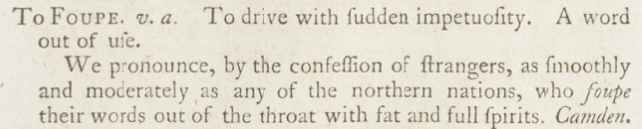
Figure 1: Johnson included the ghost word foupe in the Dictionary because he misread the long “s” in William Camden’s historical work Britannia and thus mistook soupe (meaning a swoop) for foupe.
Associate Professor Paul Tankard of the University of Otago gave an overview of his recent research into Boswell’s Life of Johnson, in which he investigated aspects of the great book that are often overlooked and unread, and for which Boswell is given insufficient credit. Although only twenty-two when he met Johnson, Boswell already knew Johnson’s writings across their range. Whilst we value the Life of Johnson for its unique account of Johnson as a conversationalist, Boswell never forgets the great writer: he identifies many of Johnson’s minor works and expands the canon of his prose writings, proposes to edit his poetry, gives a solid literary authority for his biographical method, and provides extensive historical and critical commentary on Johnson’s major writings.
Noting that the seminar was being held on American Independence Day, Peter Hardie delivered a paper provocatively titled, “Johnson vs. the ‘Drivers of Negroes’.” Peter described Britian’s legal arrangements with its thirteen American colonies and explained the war in North America between the British and French colonists by way of background to Johnson’s pro-government pamphlet Taxation No Tyranny. Johnson’s hostility to the American colonists was given force by his abhorrence of slavery, but Peter also showed its intellectual roots in Johnson’s anonymous contributions to the Vinerian law lectures by his friend Sir Robert Chambers.
It is hoped all these papers will published, in time, in the Papers of the JSA.
There was a play being rehearsed in the room next door to our venue, from which various whoops and yowls emanated periodically throughout the day. Despite these distractions, the varied pleasures of the seminar were sufficient to dissipate (at least for the moment) a certain degree of anxiety about the Society’s continued viability. A brief, belated Annual Meeting for 2025 was held immediately the talks finished, at which a clutch of new people volunteered to serve on the JSA committee, and a newish era was tentatively signaled by enthusiasm for the proposal to adjust the name of the Society to the Johnson Society of Australasia (thus formally extending our coverage across the Tasman Sea, whilst preserving our initials).
The day’s programme finished slightly early, and 15 or so people made their way to the nearby Clyde Hotel, where conversation continued happily for another couple of hours.