


A Singular Letter from my Library: James Boswell to Ralph Churton, April 5, 1792
Matt Davis encouraged me to send in a note on an item in my library that might be of special interest to JNL readers. I have selected a signed, autograph letter Boswell wrote to the Rev. Ralph Churton, dated April 5, 1792. Boswell’s letter, written in response to a letter from Churton, is recorded as entry 271 in my recently published book, The Age of Johnson: The Library of Loren and Frances Rothschild.
Although several topics are discussed in the correspondence between Churton and Boswell, the main topics of interest are Johnson’s depression, or as it was then called, “morbid melancholy,” Boswell’s own depression, and Boswell’s responses to criticisms of his Life of Johnson.1
Ralph Churton (1754-1831) was born in the parish of Malpas, in Cheshire, in 1754. He was orphaned in his childhood, but Dr. Thomas Townson (1715-1792), the rector of Malpas, thought him a promising young man and volunteered to pay for half the costs of his education. Churton entered Brasenose College, Oxford, in 1772 and took B.A. (1775) and M.A. degrees (1778). He became a fellow of Brasenose and a clergyman in the Church of England. In 1785 he was chosen to give the Bampton lectures at Oxford.2 In 1792 he was presented with the rectory of Middleton Cheney in Northamptonshire.
In May of 1791, Thomas Dilly published the first edition of Boswell’s Life of Johnson. Rev. Churton read the first edition and thought well of it. He was, however, concerned that Johnson’s gloomy reflections on life might have a discouraging effect on readers, and he wrote to Boswell to encourage him to address this issue. On March 9, 1792, he sent Boswell a letter and a packet of material relating to the Life. Churton began his letter, by inserting a transcript of a letter he had written to a friend.3
Last week, I was reading the second volume of Boswell’s Johnson, with increasing esteem for the worthy authour, and increasing veneration of the wonderful and excellent man who is the subject of it. The writer throws in, now and then, very properly some serious religious reflections; but there is one remark, in my mind an obvious and just one, which I think he has not made, that Johnson’s “morbid melancholy,” and constitutional infirmities, were intended by Providence, like St. Paul’s thorn in the flesh,4 to check intellectual conceit and arrogance; which the consciousness of his extraordinary talents, awake as he was to the voice of praise, might otherwise have generated in a very culpable degree. Another observation strikes me, that in consequence of the same natural indisposition, and habitual sickliness, (for he says he scarcely passed one day without pain after his twentieth year,) he considered and represented human life, as a scene of much greater misery than is generally experienced. There may be persons bowed down with affliction all their days; and there are those, no doubt, whose iniquities rob them of rest; but neither calamities nor crimes, I hope and believe, do so much and so generally abound, as to justify the dark picture of life which Johnson’s imagination designed, and his strong pencil delineated.
This I am sure, the colouring is far too gloomy for what I have experienced… [H]uman life, as far as I can perceive from experience or observation, is not that state of constant wretchedness which Johnson always insisted it was; which misrepresentation, (for such it surely is,) his Biographer has not corrected, I suppose, because, unhappily, he has himself a large portion of melancholy in his constitution, and fancied the portrait a faithful copy of life. (Life, 4:300-301)
I have conversed with some sensible men on this subject, who all seem to entertain the same sentiments respecting life with those which are expressed or implied in the foregoing paragraph. It might be added that as the representation here spoken of, appears not consistent with fact and experience, so neither does it seem to be countenanced by Scripture.
There is, perhaps, no part of the sacred volume which at first sight promises so much to lend its sanction to these dark and desponding notions as the book of Ecclesiastes, which so often, and so emphatically, proclaims the vanity of things sublunary. But the design of this whole book, (as it has been justly observed,) is not to put us out of conceit with life, but to cure our vain expectations of a compleat and perfect happiness in this world; to convince us, that there is no such thing to be found in mere external enjoyments;— and to teach us to seek for happiness in the practice of virtue, in the knowledge and love of God, and in the hopes of a better life. (Life, 4:301)
Upon the whole… I am convinced that… the declarations of Scripture and the actual experience of individuals… authorize the sincere Christian to hope that his humble and constant endeavours to perform his duty, checquered as the best life is with many failings, will be crowned with a greater degree of present peace, serenity, and comfort, than he could reasonably permit himself to expect, if he measured his views and judged of life from the opinion of Dr. Johnson, often and energetically expressed in the Memoirs of him, without any animadversion or censure by his ingenious Biographer. If he himself, upon reviewing the subject, shall see the matter in this light, he will, in an octavo edition, which is eagerly expected, make such additional remarks or correction as he shall judge fit; lest the impressions which these discouraging passages may leave on the reader’s mind, should in any degree hinder what otherwise the whole spirit and energy of the work tends, and, I hope, successfully, to promote,— pure morality and true religion. (Life, 4: 301-2)
Churton also sent Boswell a copy of his Bampton Lectures, a copy of his patron Townson’s Discourses on the Gospels, and a letter written by Townson, in which Townson wrote:
Mr. Boswell is not only very entertaining in his works, but they are so replete with moral and religious sentiments, without an instance, as far as I know, of a contrary tendency, that I cannot help having a great esteem for him; and if you think such a trifle as a copy of the Discourses, ex dono authoris, would be acceptable to him, I should be happy to give him this small testimony of my regard. (Life, 4:302)
Boswell was pleased to receive the letters, the praise, and the enclosures, and he replied promptly, sending Churton the letter which is now part of my collection. Here is a complete transcription of the letter:
Recd. Apr. 9 Ans. Apr 10
Reverend Sir,London
5 April 1792
My worthy friend Mr. Langton had given me the satisfaction of knowing your favorable opinion of my Life of Dr. Johnson before I had the honor to receive your very obliging letter, for which I sincerely thank you, and I beg you may present my best respects to Dr. Townson with my acknowledgements for his kind expressions concerning my works. Such spontaneous praise I feel as the best reward of my labours. You and he, Sir, will also be pleased to accept of my thanks for the Books you have been so good as to present to me, of which I have read enough already to perceive that I shall derive more than pleasure from them.
Be assured that I take in very good part the remarks which you have made upon my book; and you will be convinced of my sincerity when you have read what I am now to say.
As to Johnson’s notion of the unhappiness of human life, I have when mentioning the Rambler (Vol. 1, p. 116) in some degree obviated any reflections against him on that head; and when mentioning Rasselas (Vol. 1, p. 186) I suggest that his “morbid melancholy” may have made life appear to him more miserable than it generally is. But the truth, Sir, is as you have judiciously observed that I myself have a large portion of melancholy in my constitution for which I am satisfied that allowance should be made. Your remark upon this important subject is so good that if you will give me permission, I will insert it as a note on “the unhappiness of human life” in my second Volume, p. 242.
I am very much pleased with your remark on the passage concerning the Burial service, and shall be very happy also to insert it.
In both instances, I request that the sanction of your name may not be refused.
My Octavo edition is now in the press; and therefore you will be so good as to let me hear from you with your first convenience. I shall esteem it a happiness to obtain your personal acquaintance, whenever an opportunity offers, and I am
Reverand Sir,
Your much obliged
humble servant
James BoswellPlease write to me under cover of John Courtenay Esq: M. P., London.5
The Yale Catalogue of the Papers of James Boswell at Yale University, 1: L369, reports that the Boswell letter in my collection, which I have just quoted, is “in James Ross’s hand” and is a single folio leaf. The letter, however, is entirely in Boswell’s hand, and it is a folio leaf folded to form four quarto pages. Figure 1 shows part of the first quarto page.
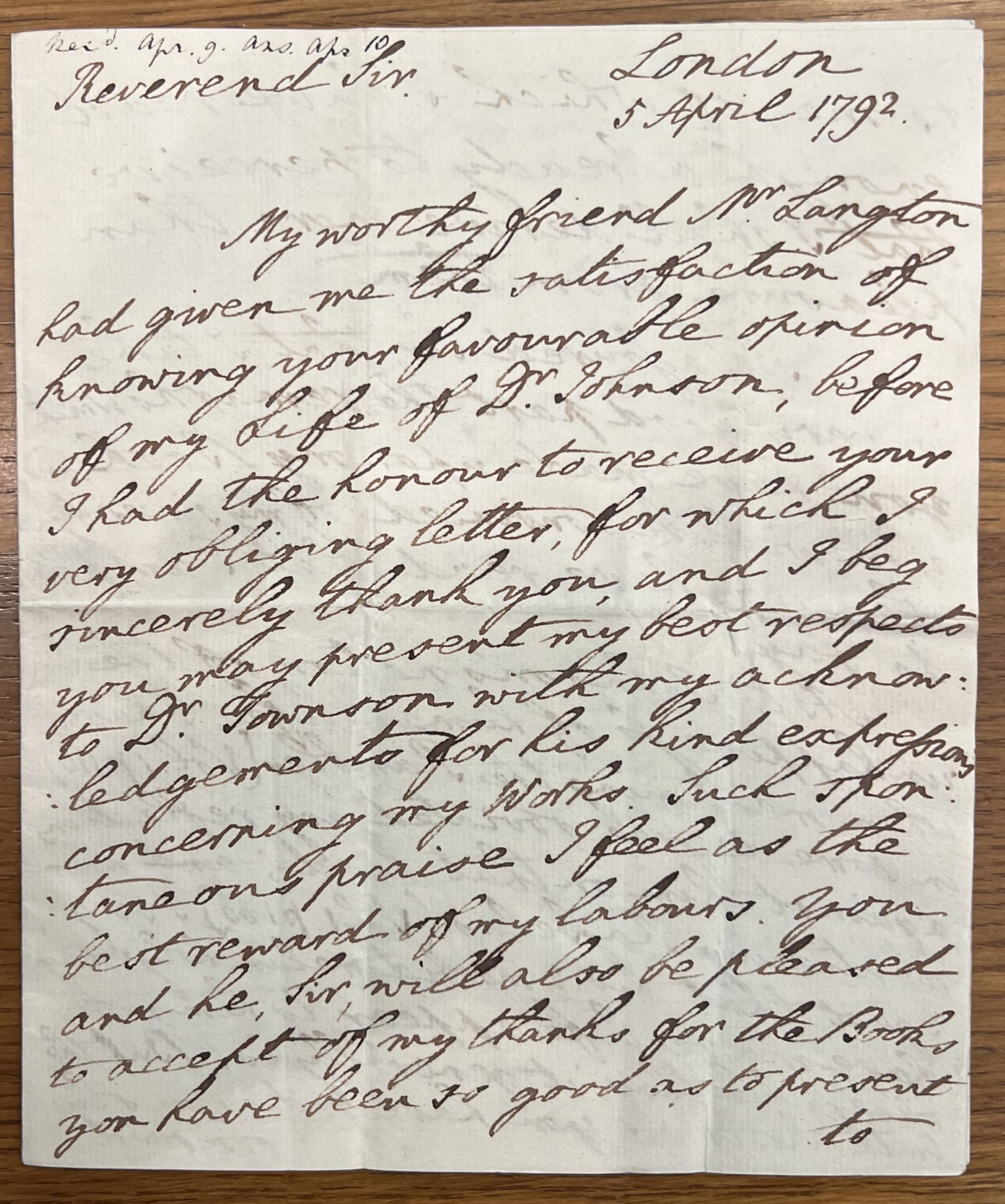
Figure 1: Letter from Boswell to Churton
After their initial correspondence, Boswell and Churton exchanged more letters. In one dated April 10, 1792, Churton expressed his gratitude for Boswell’s reception of his “strictures” and gave him permission to include them and attribute them to him in the forthcoming octavo edition (Boswell Catalogue 2:C788).
Boswell duly inserted Churton’s criticism in a footnote in the octavo edition. (Life, 4:300 n. 2.) After quoting Churton’s comments on Johnson’s pessimism, Boswell added: “I am obliged to Mr. Churton for complying with my request of his permission to insert his Remarks, being conscious of the weight of what he judiciously suggests as to the melancholy in my own constitution. His more pleasing views of life, I hope, are just. “Valeant quantum valere possunt.” (Let them stand for whatever they are worth.)
On July 26, 1793, Boswell sent Churton a presentation copy of the second (octavo) edition of the Life. In his covering letter he noted that he had read Churton’s Bampton lectures “with more than ordinary satisfaction” (Life 4:534). “They indeed served as cordials to me, while I was under confinement, in consequence of having been knocked down, cut and bruised by one of those street robbers with which London has been grievously infested this year” (Life, 4:534).
On September 23, 1793, Churton thanked Boswell for sending him a copy of the Life (Boswell Catalogue 2:C789).
Churton went on to become a distinguished clergyman. In his later years he was associated with the group of high church Anglican divines known as “the Hackney Phalanx.” Peter Nockles described him as “an exemplar of orthodox churchmanship.”6 In his Apologia Pro Vita Sua, Newman recognized him as a “high Church dignitary of the last century.”7
The book that documents my collection, The Age of Johnson: The Library of Loren and Frances Rothschild (ISBN 978-1-83636-015-5), is available to Johnsonians from Kulturalis at a discount from the retail price of $125. The book is also available on Amazon at a discount.
Another important letter by Boswell, this one to Bishop Percy, dated May 10, 1791, sheds further light on Boswell’s response to criticism of his Life of Johnson. For details, see entry 270 in my book. ↩︎
Churton’s lectures were subsequently published as Eight Sermons on the Prophecies Respecting the Destruction of Jerusalem: Preached before the University of Oxford in the Year 1785 (Oxford, 1785). ↩︎
Boswell’s Life of Johnson, ed. G. B. Hill and L. F. Powell (Oxford: Clarendon Press, 1934), 4:300-2. ↩︎
In 2 Corinthians, 12:7ff, Paul states that a “thorn in the flesh” was given to him in order to keep him from becoming conceited. ↩︎
The text is transcribed from the autograph letter in my collection. See item 271 in The Age of Johnson: The Library of Loren and Frances Rothschild (London: Kulturalis, 2025). ↩︎
Peter Benedict Nockles, The Oxford Movement in Context: Anglican High Churchmanship, 1760-1857 (Cambridge: Cambridge University Press, 1994), 17. ↩︎
John Henry Cardinal Newman, Apologia Pro Vita Sua (New York: Random House, 1950), 118. ↩︎