


Early English Periodicals and Early Modern Social Media, by Margaret J. M. Ezell
This book is part of the Cambridge University Press series called Cambridge Elements with the subheading “Eighteenth-Century Connections.” The idea of the series, as stated on the publisher’s website, is a concise expression of the general principles observable in a great many contemporary studies of eighteenth-century literature. For example, “‘Connections’ asserts that many agents contribute to the making of texts — not just authors, but also readers, reviewers, correspondents, printers, publishers.” This is to say that the findings of book history, as established by pioneering critics and historians, such as Eisenstein, Darnton, and McKenzie, are happily influential in the outlook of the series. There are similarly concise statements about the series’ “global” approach and its awareness of generic “hybridity,” but the inclusion of book history is the principle most relevant to Early English Periodicals, and it is on the whole very well observed. Unfortunately for Johnsonians, the thematic orientation of the book leads to a mere token discussion of Johnson’s Rambler at the end of an “Epilogue” that gives more than equal attention to Eliza Haywood’s Female Spectator.
The theme of this book, in keeping with remit of the Elements series, is the similarity between the English periodical in its early stages and social media as we know it today. To the author’s credit, she does not allow the development of this theme to obscure or refract her treatment of the eighteenth-century phenomenon. She is restrained in the extent to which she presses the connections, almost limiting them to the epigraphs opening the sections into which the book is divided. In fact, the main way in which Ezell makes the connection is by stressing the importance of audience participation in the development of the periodical journal. This participation brings in the “readers, reviewers, [and] correspondents” in the “Connections” statement quoted above. Although the book is admirably adherent to its theme, it comprises a fairly standard, if excellently executed, history of the genre.1
John Dunton’s Athenian Mercury predictably leads the parade of print journals: it is important in every history of the genre but particularly so here because it explicitly and creatively courted audience participation. Dunton invited the public to pose questions to his group of experts, and he answered them in print quite soon thereafter. Some of the questions were probably made up, but many, we must assume, came from real people. Swift’s first publication, an unironic panegyric to the Athenians, appeared in the journal after all, and (almost uniquely) signed with his own name. Elizabeth Singer Rowe contributed a large amount of poetry and established her name in the journal. Most of the contributions were, however, anonymous and therefore hard to verify.
The Philosophical Transactions of the Royal Society gets an early mention in this thematic review of the periodical because the editor reached out, at least, to friends and contacts to gather copy. The contributors are genuine in most if not all cases. The same is true for the Gentleman’s Journal, which gets deserved attention as well. Then there is Defoe’s Review, which flirts with including its audience and sometimes suggests it is the product of a society — like the Athenian Society in Dunton’s work — but is actually all the work of the amazingly productive Defoe. Still, the fiction or supposition of communal creation is taking hold.
With the most successful attempt at audience involvement, the genre reaches its peak of success. This is, as in other histories of periodicals, the productions of Addison and Steele — the Tatler (1709-11) and the Spectator (1711-14). Many if not most of the letters to these journals are, unlike the letters in many other journals, from real readers. It is a testimony to the success of these periodicals that the authors were sent more letters than they could publish. Two volumes of unpublished letters were published well after the series were complete, and another volume appeared in 1959 following the exhumation of some of Steele’s papers. The fiction of communal creation is also present, and in one case at least it is said to encourage a similar periodical. The introduction very early (No. 10) of Isaac Bickerstaff’s sister Jenny encourages the launch of the Female Tatler. This relatively short-lived periodical gets perhaps disproportionate attention, but the attention is justified because its relative failure tells an important part of Ezell’s story. Whereas readers were able to penetrate the disguise of Isaac Bickerstaff — a character whom Swift created as part of his pamphlet war with the astrologer John Partridge — and find the well-known authors Steele and Addison, they were not able to be sure of the identity of the female tatler, Mrs. Crackenthorpe, “a Lady that knows everything.” In fact, her identity is not yet known for sure.
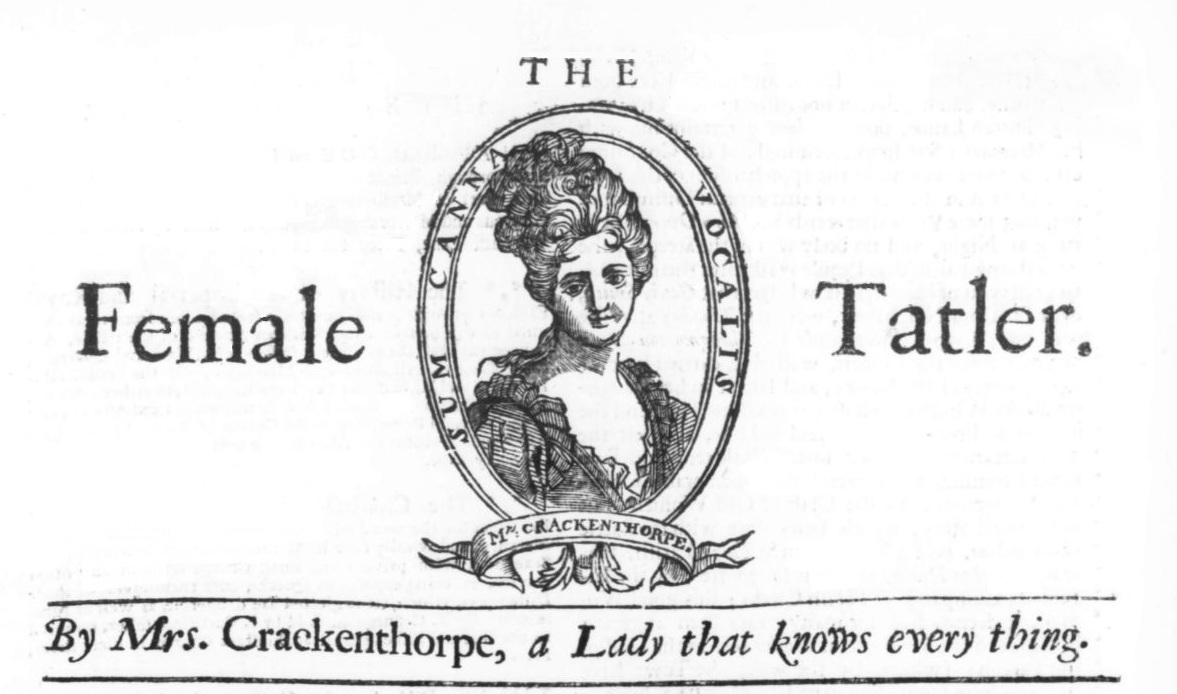
Figure 1: Masthead of The Female Tatler
The twist in Ezell’s story is that communal involvement as a key to success in the publication of journals yields before mid-century to the growing interest in celebrity authorship. This is why Johnson’s Rambler appears mainly in the epilogue. It shows what happened to the genre when it stopped touting the importance of the “many agents contribut[ing] to the making of texts.” Ezell accurately reports (and unnecessarily repeats) Johnson’s statement in the last Rambler that he “never complied with temporary curiosity, nor enabled my readers to discuss the topick of the day” (Yale 5.316). This is the end of the story. It does not breach the comparison between social media and early periodicals because, quite obviously, celebrity is important to the success of social media as well. Perhaps, in fact, applying Ezell’s history of the periodical, we should expect the importance of celebrity to exceed the importance of participation in social media in our time and lead to a winner-take-all kind of literary economy, like that playing out in the so-called real economy.
In sum, this is an excellent survey with a persuasive point of view. My only serious criticism is that it could have been executed using secondary sources — including some excellent work by Ezell! — and that the importance of the literary features of the essays is somewhat neglected. When Ezell notes that the Female Tatler failed partly because it did not “possess elegant prose to propel it into the canon of English literature” (67), one is reminded that notice of this feature of essays in the periodicals has been lacking. Even here, it is not the prose itself that causes failure but the exclusion from the canon to which uninspiring prose contributed. In Ezell’s defense, however, an aesthetic survey of the genre was not in her remit, and there are other works — one could start with Johnson’s Life of Addison — that pay plenty of attention to the prose of the journals treated here.
Although they certainly do not diminish the overall excellence of the book, there are some irritating typographical errors: 1. in almost every case an apostrophe before a contraction, such as ’em, is rendered as a closing single quotation mark (’); 2. there are some misspellings of important names; 3. there is an instance of diplography (69); 4. there are a few truncations of words (e.g., “fictious,” 70). Also, Johnsonians who have consulted Fleeman’s bibliography will bridle at the “ballpark” accuracy of the bibliographical information on the Rambler. ↩︎