


Writerly Hate in Eighteenth-Century Britain, by Thomas Leonard-Roy
Thomas Leonard-Roy has produced a provocative, well-written, and well-researched original study that centers on the relationship between his topic, hate, and five of the eighteenth century’s most important figures: Pope, Johnson, Boswell, Horace Walpole, and Frances Burney. There is no doubt that such a study could not have been written before the advent of search engines, but this is not a criticism here, for the author has used this tool, first of all, to call our attention to a concept far more pervasive in the century than most of us thought, and, second, as a lead into some new critical readings of familiar works and authors.
“The Golden Age of Hate” is the eighteenth century, according to a fine introduction, which outlines why the study will deal not just with hatred expressed within the literature but also with hatred expressed toward the writers themselves. It may indeed be true that at the time literary audiences “read to hate.” The term was both obvious and a bit slippery. Johnson referred to a very good friend, Richard Bathurst, as “a good hater,” certainly a compliment. Swift is quoted: “We have just Religion enough to make us hate, but not enough to make us love one another.” Though the word may not always connote the same today as in Johnson’s day — Leonard-Roy properly observes that it seemed less tinged with violence — everyone knew what hate was. Another important observation, that “authorial hate provok[ed] readerly disdain,” leads into the first, and perhaps best, chapter in the book, “Late Pope and the Poetics of Hate.” “The paragon of malefic satire that Pope became in the 1730s guaranteed that generations of readers and critics would in turn find ample justification to hate him.”
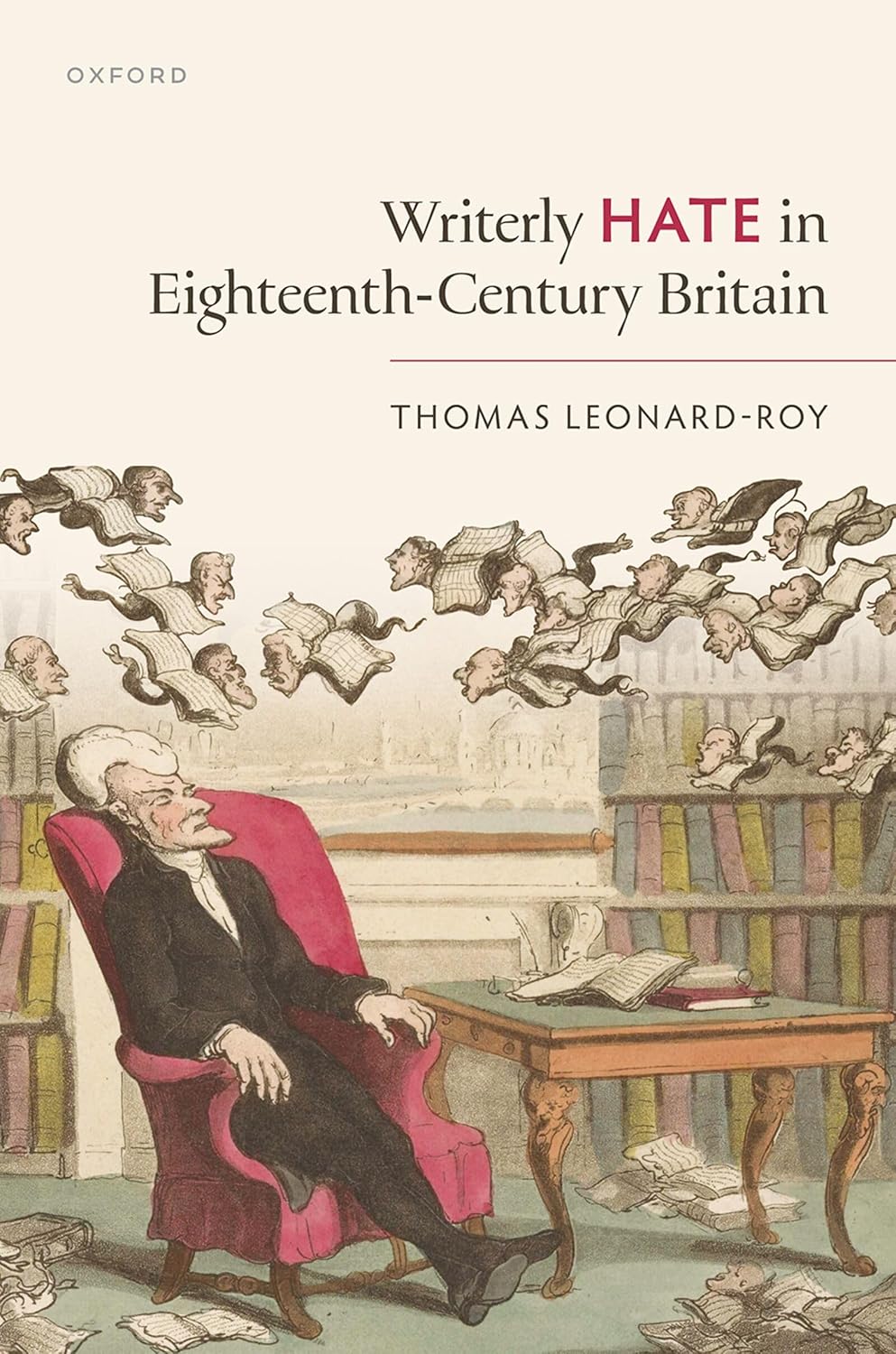
Figure 1: Cover of Writerly Hate in Eighteenth-Century Britain
The chapter on Pope focuses on his satires, of course, and on his literary feuds, most extensively with Lady Mary Wortley Montagu. In a personal aside, I reviewed recently a book (Sperrin, State of Ridicule: A History of Satire in English Literature) that treats satire from the classical to the modern period as primarily concerned with politics. For the eighteenth century at least, the case for hatred in all its forms rather than only political seems much stronger. Leonard-Roy is a fine close reader, something difficult to illustrate in a review. I will quote one passage, at some length. In the First Satire of the Second Book of Horace, Leonard-Roy writes, “Pope saved his most brutal couplet… for Lady Mary.” He writes a relatively mild couplet, which “sets up the real blow, against Lady Mary, who inflicts torment whether as lover or hater: ‘From furious Sappho yet a sadder Fate, / P—x’d by her Love, or libell’d by her Hate.’
After the iambic regularity of the first line in the couplet, the punch of ‘P—x’d by’ spews disdain… What was implicit in the lines from the Dunciad is now cruelly plain: Lady Mary is not just a prostitute, a ‘batter’d jade,’ but she is also syphilitic. At the same time as it embellishes the Lady Mary-in-a-brothel scenario, ‘pox’d’ refers cruelly to her harrowing struggles with smallpox and ridicules her campaign to introduce inoculation for the disease into Britain. (31)
The chapter concludes with “A Brief History of Pope-Bashing.” Not developed is the concept of the satiric persona, made popular especially by Pope’s scholarly defenders in the second half of the twentieth century but actually anticipated, to a certain degree, as Leonard-Roy mentions in a slightly different context, by the defenses of satire written by Dryden and others. The survey of scholarship is delightful reading: for example, discussing the critics’ compromise, Leonard-Roy observes, “it remained common to admire the verse and disdain the man.” And after mentioning the poet James Reeves (1909-78) — “Reeves was perhaps the last great Pope-basher” — Leonard-Roy concludes the chapter with a brief summary of one man’s reaction to the Laura Brown-Felicity Nussbaum collection, The New Eighteenth Century: “one scholar obliquely [called] its contributors the dunces of the academy.” (A note suggests the unnamed scholar was Donald J. Greene, about whom more later.)
Leonard-Roy shifts gears in the chapter on Johnson, leaving poetry behind to discuss “the hazards of hating in conversation and in criticism.” Ideas introduced early are treated in more detail here, including that the Johnson we all know as one who would always talk for victory got as good as he gave: “He was the constant subject of gossip and fake news, with newspapers periodically claiming that he was dying or had gone completely blind or mad.” What Johnson meant by “a good hater” is further explicated: “When he called Bathurst a good hater… he was not referring to the sort of vicious personal hate forbidden by his faith, but rather to a moral hatred of sin, good hatred, the sort endorsed by scripture. As one nineteenth-century religious writer expressed it when discussing Ecclesiastes 3:8 (’A time to love, and a time to hate; a time of war, and a time of peace’): ‘to be a good hater in that sense is but to be, so far, a good man.’” Leonard-Roy mentions Johnson’s disputes with Soame Jenyns and those sparked by his Lives of the Poets, all well-known, but he gives more attention to Johnson’s dispute with Jonas Hanway, a noted philanthropist and thus seemingly a bad target, perhaps because such a target might suggest “how negative criticism, no matter its claim to impartiality, has a way of rousing suspicions that the critic is simply malicious.” This leads him back to modern scholar Donald J. Greene (the “J” stands for “Johnson,” by the way), and I would like to spend a little time on this section, for it seems one of the rare occasions when Leonard-Roy does not give us the whole story.
Leonard-Roy discusses in some detail the participants in “the controversy in the mid-1990s around Johnson’s supposed Jacobitism, which pitted Donald Greene, Thomas Curley, and Howard D. Weinbrot, all based at American universities, against the British scholars Jonathan Clark and Howard Eskine-Hill.” Indeed, the debate was acrimonious, as debates involving Greene frequently were, but I think Leonard-Roy may have missed an important context. As Clark was in a real sense making his bones by taking on the current dean of Johnson studies, Greene had done the same thing decades earlier among the previous generation of Johnsonians, by stressing “Johnson’s Johnson” rather than “Boswell’s Johnson.” In the mid-fifties, not many so-called Johnsonians actually read Johnson. Rather they read, and taught, Boswell. The dominant undergraduate anthology before the Norton appeared was Major British Writers, where fewer than ten writers were included for our period and one entry was joint, “Johnson-Boswell,” in which Johnson’s writings were almost exactly balanced with sections from the Life of Johnson. Greene systematically argued that Johnson was by far the more substantial writer and that Boswell’s depiction was often wrong or highly limited. Once he calculated exactly how many days during their twenty-two-year friendship Boswell was in Johnson’s company — shockingly few it turns out. Although I and others often pointed out in print that it was not necessary to denigrate Boswell in order to elevate Johnson, Greene, with his heavily-fact-based approach, presented in a polemical style, did much more to advance Johnson studies than did most of the other Johnson scholars at the time. Moreover, in a book on hate, Leonard-Roy may be eliding controversial style with emotion. William F. Buckley certainly hated Gore Vidal (and vice versa), but it is unlikely that he hated many of the vast number of those he debated contentiously on his weekly television show for four decades. To be fair, Leonard-Roy may recognize this issue — he comments briefly on how tone could mitigate hatred and how a desire to be humorous may have motivated Johnson in some of his comments. Also, he is at some pains to separate Johnson’s “roughness” from his hate. Still, a semantic problem is present here and in the next chapter, on Boswell.
Leonard-Roy believes Boswell hated only three people: Giuseppe Baretti, Edward Gibbon, and John Horne Tooke. His personal journals, discovered and published in the modern period, reveal that he mostly “reserved [his] hate for himself.” The author’s thesis in this chapter is that the London Journal displays ebullience and charm but also Boswell’s “chronic self-loathing. “Those dark feelings,” Leonard Roy writes, “were inseparable from his Calvinist upbringing and continued struggles with Christian doctrine and worship.” In a nutshell, then, “his severe Calvinist upbringing had permanently darkened his being.” This reading is potentially correct, but I have my doubts. First, the religious issues discussed here were even more complicated than the complicated summary. Sure, it may be true that “Boswell’s very devotion to his journal was Calvinist, a daily concern with holding himself to account,” but when Samuel Johnson encouraged him to keep up his journal, was he encouraging him to become a better Calvinist? I think not. Leonard-Roy returns to Donald Greene — it is impossible to resist using the language of the book and therefore call this “Greene-bashing” — linking Greene’s view of Boswell with that of Macaulay and much later of Claude Rawson. To sum up, the view of Boswell as a self-hater is well-argued. The source of that self-hatred, a Calvinist rearing, less so. Since we are in the world of psycho-medicine, I might suggest a clinical reason instead. Could Boswell have been one of those alcoholics whose drinking manifests itself often in depression? (His drinking is noted repeatedly by Leonard-Roy, but not to this end.)
The concept of hate, somewhat stretched by the previous chapter, reaches a breaking point in “Horace Walpole and the Pleasures of Contempt.” Walpole’s familiar letters, voluminous but unpublished in his lifetime, are important for scholars, being “among the richest sources for information about eighteenth-century arts, politics, and fashionable society.” I think, however, for people concerned primarily with literature, learning that he was a private hater, that his preferred style of hating was “indifference and contempt,” and that “public hate… risked causing him embarrassment” are not of great interest. I think everyone will enjoy reading this chapter once, if only for quotations like this one from William Beloe (1758-1817), who wrote that Walpole was “in the truest sense of the word, a perfect courtier… consummately insincere.” But few of us will want to read it a second time. Since Leonard-Roy does a good job in various spots of referring to marginalia found in his subjects’ private libraries, I will share an excerpt from this reviewer’s marginalia on this chapter. Leonard-Roy writes that Walpole “articulated a gentleman-amateur’s disdain for the world of professional letters and authorship.” In the margin I scribbled, “This sounds like simple envy to me. Walpole wanted it both ways, to be famous and private. Unlike Boswell, who showed not envy but excessive admiration of the famous.”
I doubt that anyone could do a better job of finding interesting things to say about Frances Burney’s The Wanderer, or, Female Difficulties (1814) than Leonard-Roy has. He admits that “it is a frustrating novel, and widely seen as Burney’s worst. Critics call it Burney’s ‘least-known, least-liked, and most difficult novel,’ a ‘work of gigantic ambition and bewildering failure.’” A good case is made that Burney, “a brilliant satirist with a vigorous and often violent sense of humour,” was compelled during her years of service at the Court (1786-1790) as keeper of the Queen’s robes to stifle her feelings, and that the plot of her last novel displays a heroine in many of the same circumstances. I am convinced also by the argument that the novel shows Burney exacting her revenge years later, in fiction, where she could drop the mask of deference she had to wear at Court. The chapter could stand alone; in fact, in his conclusion the author seems to hint at a possible objection to including it in this book: “if anyone knew how resentment and bitterness, if not hate, could coexist with love and loyalty to one’s mistress, it was probably Burney” (my emphasis).
The Coda, a mere seven pages, matches the chapter on Pope as the best section in the book. English Bards and Scotch Reviewers (1809) had positioned Byron “as the heir to Pope and Swift, wielding poetry to settle personal scores and denounce English culture.” Here is an especially good observation on a passage from Don Juan:
This collection of allusions — Johnson and Cervantes, with Swift’s withered tree in the background — shows Byron dwelling on fundamental questions about how he feels in his poetry and its effect on his sanity. He celebrates Johnsonian good hating before candidly admitting his misgivings about his own hate, and finally turns to Cervantes’ deranged knight in a reflection on how he must prevent his own quixotic nature from driving him mad. (184)
To conclude with praise about something that used to be mundane or expected, but no longer is, I found the book carefully written and carefully proofed. I spot checked four longer quotations, and they were perfect. The only two suggestions I would have had, and both are a bit of a strain, are these. I would have preferred “had sneaked back into England” instead of “had snuck,” and instead of “Piozzi had effectively lived with Johnson for years while married to Henry Thrale,” perhaps “Johnson had effectively lived with Piozzi for years while she was married to Henry Thrale.”