


The Enlightenment: An Idea and Its History, by J. C. D. Clark and Enlightened Oxford: The University and the Cultural and Political Life of Eighteenth-Century Britain and Beyond, by Nigel Aston
Do things come into existence only once they have been named? The Bible suggests otherwise:
And out of the ground the Lord God formed every beast of the field, and every fowl of the air; and brought them unto the man to see what he would call them: and whatsoever the man called every living creature, that was the name thereof. And the man gave names to all cattle, and to the fowl of the air, and to every beast of the field…1
Common sense tells us that rivers and mountains and trees must have existed before any person named them. Everybody who died before William Harvey published De Motu Cordis in 1628 was necessarily ignorant of the circulation of the blood; and yet their blood certainly circulated, just as ours does, even though that phrase, “the circulation of the blood,” had yet to be spoken. But perhaps things may be different in the symbolic order of human opinion. There it does seem to be at least worth investigating whether or not something truly exists before a label has been devised for, and attached to, it.
J.C.D. Clark’s contention in The Enlightenment: An Idea and Its History is that, in the case of the Enlightenment, the label was not retrospectively attached to something it accurately although belatedly represented. Rather, the label reified and distorted a congeries of tendencies and elements in eighteenth-century culture which were later simplified into something called “The Enlightenment.” In a much-repeated formulation we are frequently told that, in the long eighteenth century, enlightenment was everywhere, but the Enlightenment nowhere. The Enlightenment, we are to believe, was reified and the label devised only very late, some two centuries after the intellectual developments it was used to identify had occurred. The currents of ideas that later were grouped and disciplined into an “Enlightenment” were, so we are told, in fact more diverse and unfocused that the retrospective label would lead us to believe.
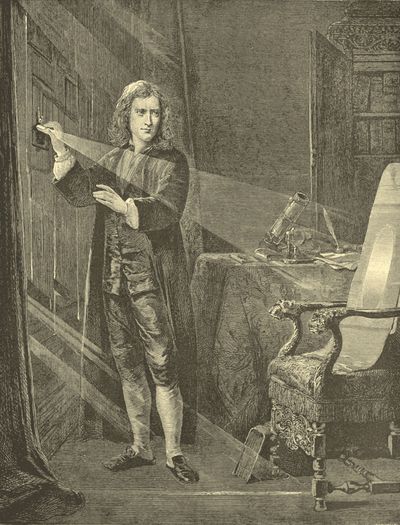
Figure 1: Engraving of Isaac Newton separating light with a prism, 1880
The Enlightenment: An Idea and Its History is divided into three parts. Part One, “Absences?”, reviews the writings of a number of eighteenth-century authors whom one might have assumed were some of the personnel of the Enlightenment, here taken to be a movement involving reason, a belief in progress and even perfectibility, a reliance upon empirical science, a confinement of religion to the realm of private opinion, in politics a focus on the design of institutions calculated to promote human flourishing in this life, and a commitment to freedom, justice, and equality. The purpose of Part One is to demonstrate that, when examined closely, the writings of these figures — D’Alembert, Rousseau, and Voltaire in France; Locke, Hume, Wollstonecraft, Godwin, Price, Priestley, and Paine in Britain — do not conform to this stereotypical Enlightenment. It is perhaps surprising that Gibbon was not given extensive consideration, particularly since the work of John Pocock has installed The Decline and Fall at the center of the enlightened endeavours of at least the English eighteenth century. Had Gibbon received the attention bestowed on Price or Godwin, it would have been difficult to have overlooked this comment in chapter 61 of The Decline and Fall: “On this interesting subject, the progress of society in Europe, a strong ray of philosophic light has broke from Scotland in our own times; and it is with private, as well as public regard, that I repeat the names of Hume, Robertson, and Adam Smith.” Although the phrase “the Enlightenment” is to be sure not used here, nevertheless this does look rather like an identification of what later came to be called “the Enlightenment.” But of course, as we are told, interpretation demands selection. Part Two, “Anticipations?”, embarks on a similar voyage, this time to discredit the attempt to create a genealogy for Enlightenment by earlier trends which might be thought to have contributed towards it. Part Three, “Achievements?”, describes the eventual coining of the term “the Enlightenment,” and exposes the various and allegedly unhistorical motives which led to it.
A term of art frequently encountered in the pages of The Enlightenment: An Idea and Its History is “retrojection,” here used to refer to the misleading importation into the past of language or concepts that came into existence only later. In this account, “the Enlightenment” itself is the prime example of such an act of retrojection. It is curious, therefore, that the argument of The Enlightenment: An Idea and Its History rests upon a massive retrojection, namely the tailoring of the discussion to fit the requirements of a late twentieth-century political agenda. What is that agenda? Here we might attempt a reifying retrojection of our own, and coin the label “the Petrean Revanche.”
What was “the Petrean Revanche”? It was a twentieth-century historiographical tendency arising from and focused upon Peterhouse, Cambridge. There were two pillars. The first was the sometime master of the college, the Methodist and adulterer Herbert Butterfield. His contribution to the “Revanche” was a hostility to teleological historical narrative, as embodied in his classic The Whig Interpretation of History (1931) — although it should be noted that, when it seemed possible that his (ultimately successful) campaign for the Regius Chair at Cambridge might be enhanced by something a bit more patriotic and less iconoclastic, Butterfield had no difficulty in reversing the argument of his earlier book for The Englishman and His History (1944). The second pillar was the dyspeptic Tory Maurice Cowling, who in a sequence of monographs presented a series of what one might carelessly have considered to be staging posts on the way to modernity — franchise reform, the rise of the Labour Party, and the defeat of Nazism — as in fact moments when the Conservative élite strengthened its hold on power. And there were a number of lesser members of the Revanche — what one might call pilasters — such as the architectural historian David Watkin and the ecclesiastical historian Edward Norman.
How does The Enlightenment: An Idea and Its History fit into the Petrean Revanche? The cat is allowed to peep from the bag in the closing pages, where we read that:
Its account [i.e., the account offered in The Enlightenment: An Idea and Its History] of ‘the Enlightenment’ finds the formation of that anglophone concept in the era that is now widely identified as ‘modernism’, the mindset (to simplify) held (in one interpretation) to be the appropriate expression of societies dominated by manufacturing industry, urbanization, mass democracy, and secularization. The concepts employed to express that mindset, and to impose its normative projects on a variety of subject matters, shared a common characteristic: those concepts, often new in the nineteenth century, became heavily reified in the twentieth to the point that they came to seem beyond question. (482-83)
“The Enlightenment,” we are to believe, was “among the last of these concepts to be coined and to survive, but proved to be among the most powerful.”
To the extent that an historical event — in this case, the advent of “modernism” — can be presented as less the outcome of the longue durée, and more the disguised product of local and contingent considerations, to that extent the possibility of halting, overturning, or even reversing it seems more possible. In such a Quixotic cause no price might seem too high to its devotees — even, it may be, the reshaping of historical scholarship from a dispassionate survey of all the relevant evidence to the cherry-picking of helpful details, and the overlooking of the rest.
It is, then, with some relief that one turns to Nigel Aston’s Enlightened Oxford: a comprehensive and untendentious survey of the intellectual life and social and political connections of the university during the eighteenth century. In the many decades since Edward Gibbon and Adam Smith inserted their stilettos between the shoulder blades of their alma mater the astonishingly durable image they sketched of Oxford — lost to all worthwhile academic activity, the home of unproductive drones saturated in port and prejudice, addicted to the increasingly Brigadoon-like cause of Jacobitism — has received at least in part an empirical corrective, not least in the multi-volume history of the University published by OUP. Gibbon and Smith provided a caricature rather than a portrait, and the detail of the life of the university in the eighteenth century, here lovingly and learnedly curated by Aston, tells a different story. Not, it must be said at once, a tale of white-hot academic endeavour and undeviating Hanoverian loyalty; but rather a more interesting and plausible story of how an institution of more than national importance adjusted and preserved itself in the aftermath of high-political events (1688 and the Hanoverian succession of 1714) that threatened to destroy it.
Aston has rightly given priority to richness of detail over elegance of argument. This is a wonderful book in which to dip — it is almost a bedside book, at least for those who nurse a curiosity about Oxford. It is at one level a treasure-trove of Oxonian anecdote — for instance, the story of the so-called “Vinegar Bible” of 1717, “strewed with misprints… that did nothing for the reputation of proofreaders” at the University Press. Would that one could say that the press had put those days well and truly behind it. For although Enlightened Oxford is a very handsome and generously-illustrated book, it is disfigured by a sprinkling of errors of presentation. Italicization of titles of books is very haphazard, particularly in the epigraphs to chapters. Underlinings, presumably made at proof stage, have from time to time survived as underlinings rather than being converted into italicisations in the final text. Occasionally what look like proofing instructions have been taken over literally into the text, rather than being realized in a correction. Some cross-references have not been updated (e.g., p. 132, n. 4). Not all the errors, however, can be laid at the door of the press. It is, for instance, surprising to learn that John Locke’s Two Treatises of Government was one of the books burned by the University in 1683 on the grounds of its “damnable Doctrines,” since the Two Treatises were not published until 1690 (p. 40).
But it would be wrong to let the final emphasis fall on slips and errors. This is a rich and rewarding study, comprehensive in its scope and unwaveringly fair-minded in its judgements.
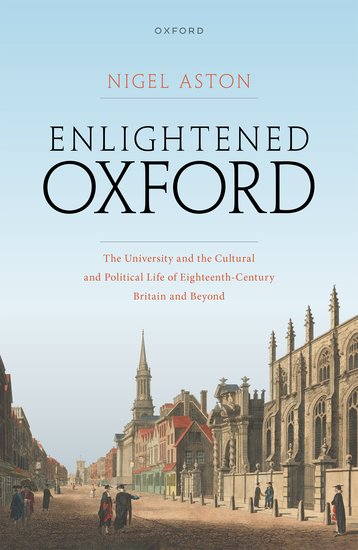
Figure 2: Cover of Enlightened Oxford
Genesis 2:19-20. ↩︎